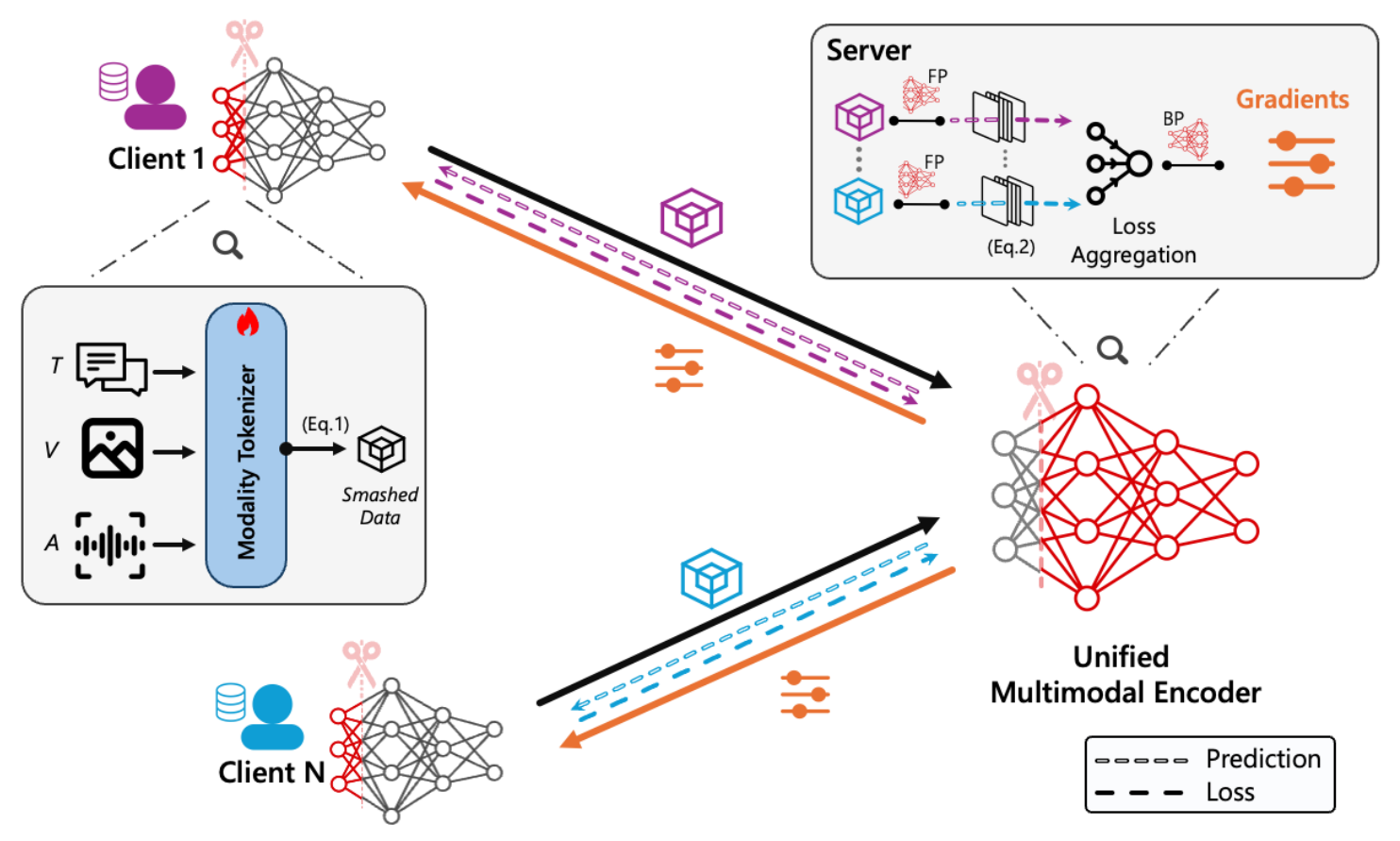
Multimodal fine-tuning can overwhelm an edge device even when few parameters change. MPSL keeps lightweight tokenizers on clients and runs a shared transformer on the server, coordinating training through local losses and returned gradients.
One training step · Late fusion
Client AInputs · yA = 2
Client BInputs · yB = 3
Local tokens
On device
Shared serverEncoder + head
ON EACH CLIENT
Small tokenizers, local inputs
AClient AImage + text
How many?
Image tokenizerText tokenizer
BClient BImage + text
How many?
Image tokenizerText tokenizer
■ Image tokens▰ Text tokens
Image + text · Local tokenizers · Token activations
Client AInputs · yA = 2
Client BInputs · yB = 3
Activations
In parallel
Shared serverEncoder + head
CLIENTS → SERVER
Parallel streams → one server
ATokens
BTokens
Server input
A
B
Two clientsParallel token streams
Token activations → server · Raw inputs stay local
Client AInputs · yA = 2
Client BInputs · yB = 3
Predictions
For each client
Shared serverEncoder + head
ON THE SERVER → CLIENTS
Encode → fuse → predict
ATokens
BTokens
One modelShared encoder
ImageText
Same weights
Join → pool → head
ŷAA
Join → pool → head
ŷBB
Late fusionWithin each client’s sample
Shared weights · Late fusion · Predictions → clients
Multimodal splitting: support paired image, audio and text inputs with one shared encoder.
02
Shared optimization: aggregate client losses for one server backward pass while keeping raw labels local.
03
Task-dependent evidence: measure accuracy, retrieval, client compute and communication across seven datasets.
Abstract
Multimodal transformers integrate diverse data types like images, audio, and text, advancing tasks such as audio-visual understanding and image-text retrieval; yet their high parameterization limits deployment on resource-constrained edge devices. Split Learning (SL), which partitions models at a designated cut-layer to offload compute-intensive operations to the server, offers a promising approach for distributed training of multimodal transformers, though its application remains underexplored. We present MPSL, a parallel SL approach for computational efficient fine-tuning of multimodal transformers in a distributed manner, while eliminating label sharing, client synchronization, and per-client sub-model management. MPSL employs lightweight client-side tokenizers and a unified modality-agnostic encoder, allowing flexible adaptation to task-specific needs. Our evaluation across 7 multimodal datasets demonstrates that MPSL matches or outperforms Federated Learning, reduces client-side computations by 250×, and achieves superior scalability in communication cost with model growth. Through extensive analysis, we highlight task suitability, trade-offs, and scenarios where MPSL excels, inspiring further exploration.
Image patches, audio spectrogram patches and text tokens provide compatible inputs to a modality-agnostic transformer. Clients run the tokenizers; the server runs the encoder and task head.
Section 3.1–3.2 and Figure 1 · public preprint, pp. 2–4.
02
Fuse at the right stage
Early fusion concatenates token sequences before encoding. Late fusion encodes modalities independently with shared weights and concatenates their representations afterward. The useful choice depends on the task and modality pair.
Section 3.2 and Table 5 · pp. 3 and 7.
03
Minimize the combined client loss
Predictions return to clients for loss calculation. The server weights each loss by its share of the global batch, backpropagates once, then returns cut-layer gradients to the local tokenizers.
Equation (4), p. 4. ℬn is client n’s batch; ℬ is the combined batch. This avoids client-weight synchronization during training, not all coordination.
04
Construct the evaluation model
After training, the reported comparisons average the client tokenizers and join them with the shared server model. This post-training aggregation is distinct from the loss-based training loop.
Original paper figures & sourcesEnlargeLightweight tokenizers run on each client. A shared server encoder processes the modalities and uses aggregated client losses for one backward pass; training labels stay on the clients. Figure 1 in the public preprint Evaluation
Results
Small client models, similar mean accuracy
Mean accuracy · 5 classification tasks · 100 clients
Small client models, similar mean accuracy. Mean accuracy (%) and Trainable client parameters (M).
Method
Accuracy (%)
Params (M)
1FedAvg
67.20
43.7
2FedCLIP
45.74
3.1
3MPSL
66.64
1.0
Task accuracy and client compute
100 clients · accuracy (%) · 3-seed means · GFLOPs per input
Compute savings with task-dependent accuracy. Meta-Transformer ViT-B/16; 100 clients with Dirichlet α=0.1. Selected classification tasks, accuracy (%) with reported ± terms over three seeds; higher is better. Client GFLOPs per input are lower-is-better.