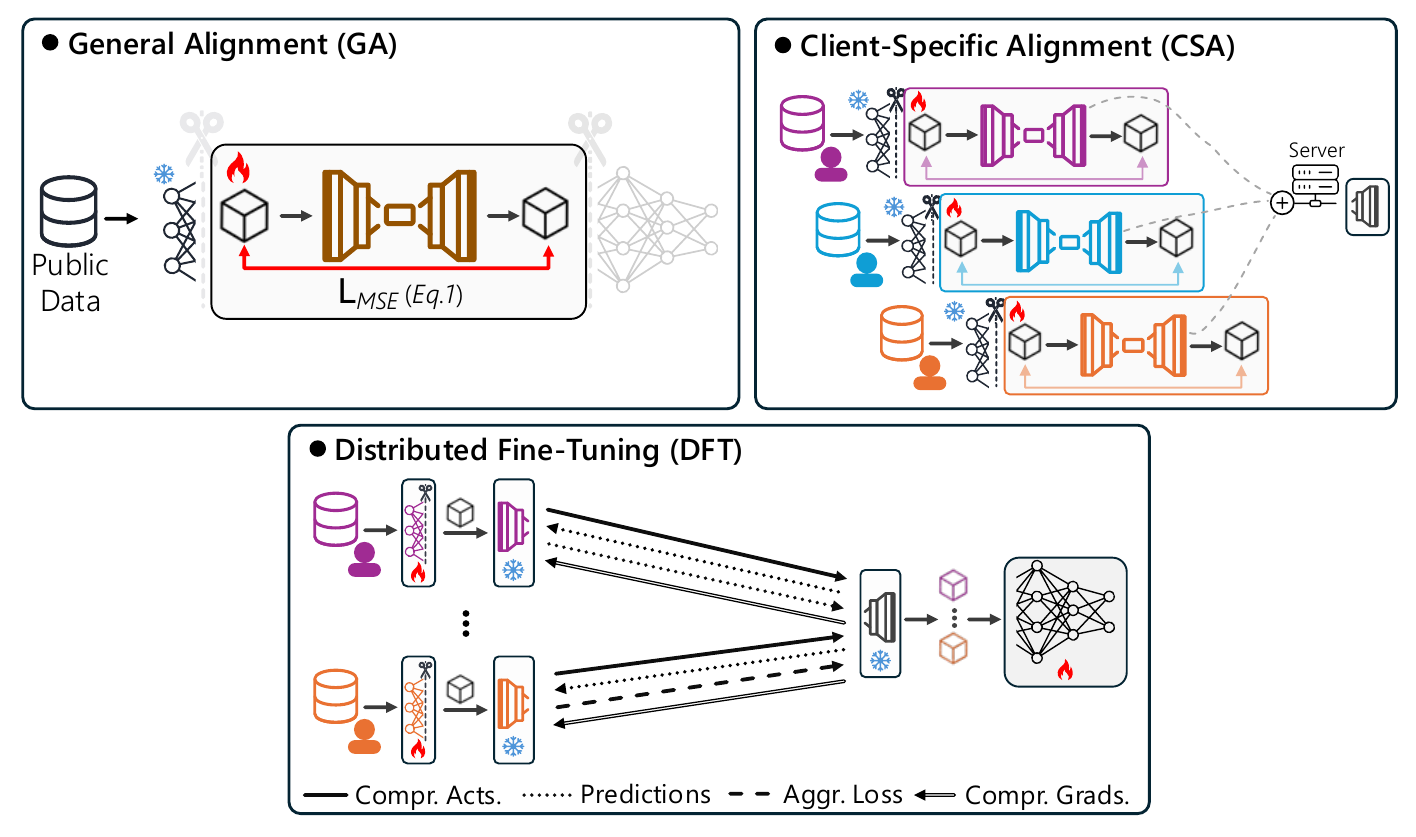
Split learning still sends activations and gradients at every training step. AE-PSL aligns an autoencoder before fine-tuning, then freezes it to compress patch features in both directions while preserving compatibility with pretrained representations.
Parallel split learning · Encoded features
Client 1Inputs + labels
Client 2Inputs + labels
E + D
→
Shared serverModel + autoencoder
GENERAL ALIGNMENT · SERVER
Learn the feature space
Public images→
Frozen feature extractor
H
ETrain
Z
DTrain
Ĥ
H
MSE‖H − Ĥ‖²
Ĥ
Aligned E + D→ each client
Public features → encoder → latent → decoder · Reconstruction loss
Client 1Inputs + labels
Client 2Inputs + labels
Local alignment
→
Shared serverModel + autoencoder
CLIENT-SPECIFIC ALIGNMENT
Adapt to each client
Client 1Local images
Frozen features
H
E1Train
Z
D1Train
Ĥ
H
MSE‖H − Ĥ‖²
Ĥ
Client 2Local images
Frozen features
H
E2Train
Z
D2Train
Ĥ
H
MSE‖H − Ĥ‖²
Ĥ
E + D adapt locallyOne local epoch
Local reconstruction · Frozen features · Train both AE halves
Client 1Inputs + labels
Client 2Inputs + labels
Decoders
→
Shared serverModel + autoencoder
ALIGNMENT → FINE-TUNING
Local encoders · shared decoder
Client 1
E1Stays local
D1
Client 2
E2Stays local
D2
→
Decoder weights onlyD̄ = mean(D₁, D₂)
Shared D̄Fixed
Freeze all E + shared D̄Start fine-tuning
Keep local encoders · Average decoder weights · Freeze compressors
Backpropagate through frozen E · Update client LoRA · Next mini-batch
1 / 6
What this adds
01
Two-stage alignment: learn public feature reconstruction, then adapt the compressor to each client.
02
Shared decoding: keep local encoders and average only decoders into one server module.
03
Bidirectional compression: exchange compact patch activations and gradients while leaving CLS uncompressed.
Abstract
Distributed Fine-Tuning (DFT) of large-scale Foundation Models (FMs) on resource-constrained edge devices is limited by local compute constraints and communication overhead. Parallel Split Learning (PSL) reduces client-side computation by keeping few model layers on each client and offloading the remaining computation to the server; however, clients must exchange intermediate activations and gradients with the server at every training step. Existing SL communication-compression methods mainly rely on task-agnostic heuristics, such as sparsification and quantization. While learnable SL compressors can better adapt to intermediate representations, they require co-training with the target model. Therefore, directly inserting them into off-the-shelf FMs introduces feature-distribution misalignment and degrades DFT performance. To address this, we propose AE-PSL, a communication-efficient PSL framework that compresses intermediate activations and gradients using a lightweight AutoEncoder (AE) placed at the split layer. To ensure compatibility of AE compression with pre-trained FMs, AE-PSL introduces a novel two-stage alignment mechanism, which adapts the AE to the pre-trained model’s feature manifold and client-specific feature distributions before DFT. We evaluate AE-PSL across four vision datasets and various communication reduction settings, showing that it preserves downstream accuracy at 10.2× reduction; at the same communication budget, the strongest evaluated heuristic baseline trails AE-PSL by 5.2 percent point. This demonstrates that AE-PSL offers a stronger accuracy–communication trade-off than heuristic SL compression.
Train the autoencoder on public features with the pretrained client partition frozen. The reported default uses ImageNet100 for 30 epochs. The reconstruction objective is reused during local alignment.
Equation (1), p. 5, compactly written as a loss. H is the frozen split-layer feature; E/D are encoder/decoder; 𝒟 is public or local alignment data.
02
Client-Specific Alignment
Each client adapts both autoencoder halves for one local epoch while keeping the feature extractor frozen. It retains its encoder and sends only decoder weights for a simple mean at the server.
Section 4.1.2 · p. 5. N is the number of clients; ψn denotes client n’s decoder weights.
03
Fine-tune through frozen compressors
With the AE weights fixed, clients send patch-token latents plus the original CLS activation. The server reconstructs patches, predicts, aggregates local losses and returns latent and CLS gradients. Backpropagation through the frozen encoder still updates the client model.
Section 4.2 · p. 6. Default: ViT-B/32, split layer 5, LoRA rank 16; four supervised vision datasets.
04
Match the inference setting to the claim
Global evaluation aggregates client weights and bypasses the AE; local FEMNIST evaluation keeps each client model and the AE active. Alignment is particularly important when the compressor is removed after training.
Section 5.2, Table 2 and Appendix A.3 · pp. 7, 11 and 21. An unaligned AE does not show the same collapse in local tests with the AE retained.
Original paper figures & sourcesEnlargeTwo alignment stages prepare the compressor before fine-tuning. Each client keeps a local encoder, while the server shares one decoder; both stay frozen during the final training stage. Figure 1 in the public preprint Evaluation
Results
Global accuracy at ≈10× compression
ViT-B/32 · 5 clients · AE bypassed at inference · mean ± SD over three seeds
Global accuracy at about 10× reduction. ViT-B/32, split layer 5, five clients, Dirichlet α=0.5; top-1 accuracy (%), higher is better. Mean ± standard deviation over three seeds. Compressed methods use R≈10; the reference uses R=1.
Method
CIFAR-100 (%)
Food101 (%)
SUN397 (%)
No compression · R=1
82.7 ± 0.2
69.1 ± 0.9
67.0 ± 0.6
C3-SL
50.9 ± 1.2
40.3 ± 1.2
41.3 ± 2.1
Rand-Top-K
76.2 ± 0.4
60.2 ± 0.2
62.9 ± 1.0
ADC
68.4 ± 0.4
54.6 ± 1.6
52.9 ± 1.1
AE-PSL
82.7 ± 0.2
69.6 ± 1.2
66.7 ± 0.3
Local accuracy at ≈20× compression
FEMNIST · 25 clients · AE active at inference · mean ± SD over three seeds