Adapt a frozen model by communicating mask changes. DeltaMask trains stochastic masks over pretrained weights, selects changes to a shared reference mask, and encodes their positions with probabilistic filters. The server approximately reconstructs those masks and updates global mask probabilities.
One federated round · Mask updates
ServerGlobal mask
Probabilities + seed
Client ALocal mask
Client BClient C
SERVER → CLIENTS
One shared starting point
Frozen backboneShared seed
Position
0102030405060708
Global probabilities
80%70%20%60%30%80%20%80%
Shared-seed sampling ↓
Shared reference
11010101
Server = Clients · Same reference
Global probabilities · Shared seed · Shared reference
ServerGlobal mask
Local training
Client ALocal mask
Client BClient C
ON EACH CLIENT
Local mask learning
Local dataMask-score learningFrozen backbone
Position
0102030405060708
Before training
80%70%20%60%30%80%20%80%
After training
85%15%20%45%90%80%60%85%
Local mask sample
10001111
1 · Weight on 0 · Weight off
Local data · Learned probabilities · Frozen weights
Client masks + Beta(1,1) prior → Next probabilities
1 / 6
What this adds
01
Mask-based adaptation: learn subnetworks while keeping pretrained backbone weights fixed.
02
Sparse change encoding: rank differing positions and compress them with a binary fuse filter.
03
Controllable trade-off: vary retained changes and fingerprint width to balance bitrate and accuracy.
Abstract
Foundation Models (FMs) have revolutionized machine learning with their adaptability and high performance across tasks; yet, their integration into Federated Learning (FL) is challenging due to substantial communication overhead from their extensive parameterization. Current communication-efficient FL strategies, such as gradient compression, reduce bitrates to around 1 bit-per-parameter (bpp). However, these approaches fail to harness the characteristics of FMs, with their large number of parameters still posing a challenge to communication efficiency, even at these bitrate regimes. In this work, we present DeltaMask, a novel method that efficiently fine-tunes FMs in FL at an ultra-low bitrate, well below 1 bpp. DeltaMask employs stochastic masking to detect highly effective subnetworks within FMs and leverage stochasticity and sparsity in client masks to compress updates into a compact grayscale image using probabilistic filters, deviating from traditional weight training approaches. Our comprehensive evaluations across various datasets and architectures demonstrate DeltaMask efficiently achieves bitrates as low as 0.09 bpp, enhancing communication efficiency while maintaining FMs performance, as measured on 8 datasets and 5 pre-trained models of various network architectures.
Transform unconstrained mask scores with a sigmoid, sample binary activations, and apply them to fixed pretrained weights. The classifier first receives one round of linear probing.
Sections III-A–C and Algorithm 1, PDF pages 4–6. The experiments target the last five backbone blocks.
02
Form and rank mask differences
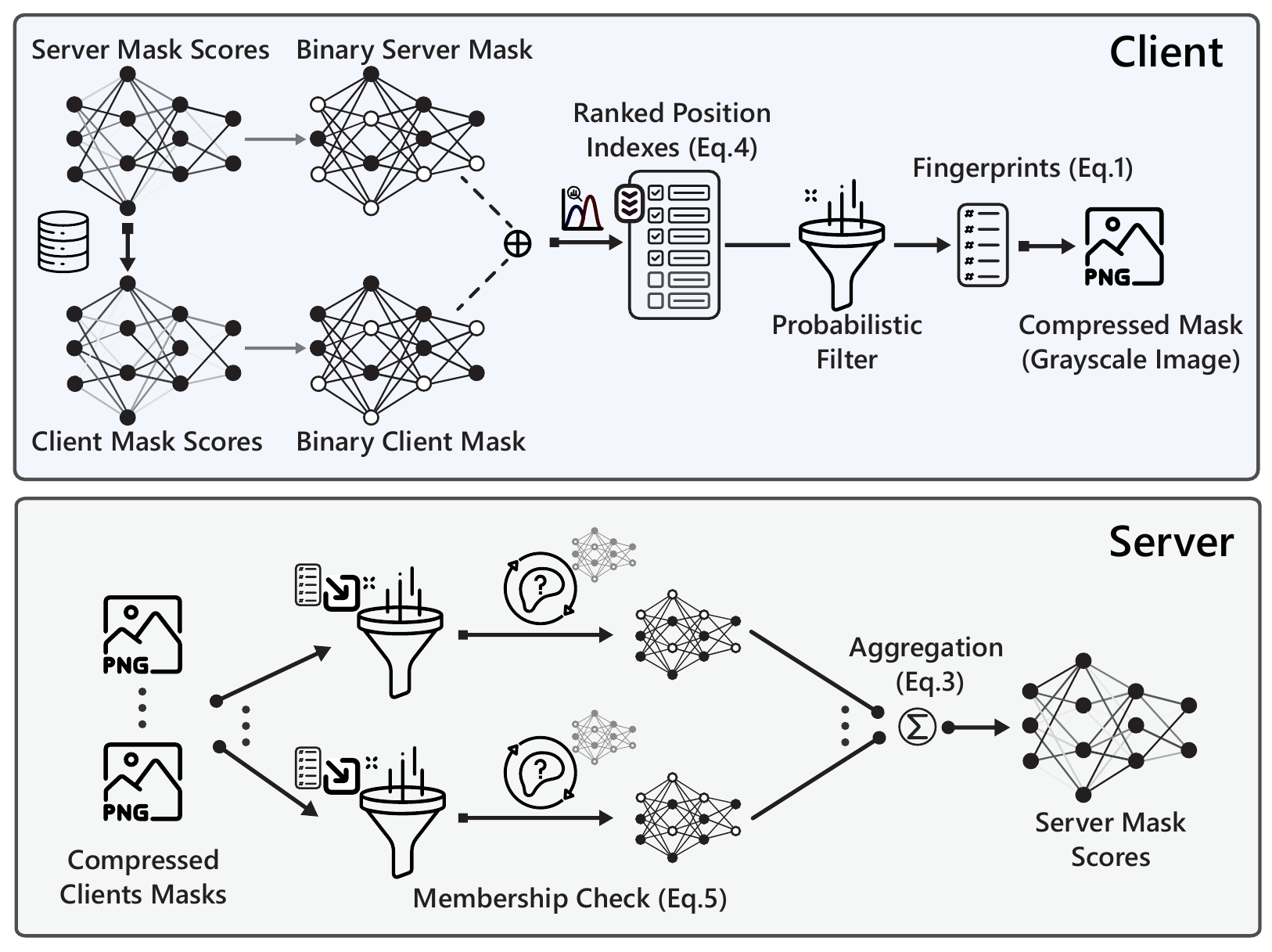
Sample the global reference with a shared seed. Collect positions where local and reference bits disagree, rank them by relative entropy of their probabilities, and retain a top-κ subset.
Section III-B and Equation 4, PDF page 5, with simplified round/client notation. The main setup schedules κ from 0.8.
03
Filter first, compress bytes second
Encode selected positions in a four-wise binary fuse filter using 8-bit fingerprints by default. PNG-like DEFLATE compression then shrinks the fingerprint bytes losslessly.
Section III-B, PDF page 5. Selection and probabilistic membership make mask recovery approximate; DEFLATE itself does not discard fingerprint data.
04
Recover masks and update probabilities
Query membership for every possible position, flip the corresponding reference bits, and feed reconstructed client masks to Bayesian aggregation for the next round.
Equation 5 and Algorithm 1, PDF pages 5–6. False positives can flip extra bits; this is not a lossless-recovery or formal privacy guarantee.
Original paper figures & sourcesEnlargeThe update is a compact record of changed mask positions. Clients rank those changes and encode them with a probabilistic filter; the server queries the filter to reconstruct and aggregate local masks. Figure 2 in the accepted manuscript Evaluation
IID data with full participation. CLIP ViT-B/32; eight image datasets, Dirichlet α=10, 30 clients, full participation, 100 rounds and one local epoch. Reported average accuracy (%) is higher-is-better; average bits per parameter (bpp) is lower-is-better.
@inproceedings{tsouvalas2025deltamask,
  title = {DeltaMask: Minimizing Communication in Federated Fine-Tuning of Vision Foundation Models},
  author = {Vasileios Tsouvalas and Yuki M. Asano and Aaqib Saeed},
  booktitle = {2024 IEEE International Conference on Big Data (BigData)},
  year = {2025},
  pages = {8042--8051},
  publisher = {IEEE},
  doi = {10.1109/BigData62323.2024.10825398},
  url = {https://doi.org/10.1109/BigData62323.2024.10825398}
}