Emotion labels are costly, while speech recordings are sensitive. This study combines spectral, temporal and channel attention with local self-training, using unlabeled speech while sharing model parameters across devices.
One federated round · Speech
Server
Broadcast
Client A
01 / 06
Speech → features
Speech 01On device
Local speech
KnownUnlabeled
Log-mel
Frequency ↑
Time →
CNN features
4 blocks
Shared modelLocal features
Local audio · Shared model · CNN
Server
Local attention
Client A
02 / 06
Time · frequency · channels
Speech 01On device
Time
Frequency ↑
Time →
Frequency
Frequency ↑
Time →
Channel
01
02
03
Channels ↗
Time×Frequency×Channel
Softmax
Weights ⊙ features
Weighted features
Three attention maps · Softmax · Reweight
Server
Local threshold
Client A
03 / 06
Participation → threshold
Speech 01On device
Participation
01020304
Threshold
Client A
τA
Client B
τB
Global progress+Client historyτk
ParticipatedMissed
Global progress + Client history → Local threshold
Server
Local filtering
Client A
04 / 06
Confidence → pseudo-label
Speech 01On device
Confidence gateτA = 0.70
Speech 01T = 2
Neutral
0.06
Happy
0.84
Sad
0.04
Angry
0.06
HappyPseudo-label
Speech 02T = 2
Neutral
0.22
Happy
0.46
Sad
0.18
Angry
0.14
DeferNo target
Confident → Pseudo-label · Uncertain → Defer
Server
Local learning
Client A
05 / 06
Two losses → one update
Speech 01On device
Known labelNeutral
Cross-entropyLs
Speech 01Happy ✓
Cross-entropyLu
+
Ls + β Lu
Local updateθA
Known labels + Accepted pseudo-labels · Joint training
Attention across three axes reweights the local model’s speech features.
02
Participation-aware self-training uses confident predictions on unlabeled recordings.
03
Four IEMOCAP partitions separate speaker overlap from how speech is distributed across clients.
Abstract
Speech Emotion Recognition (SER) refers to the recognition of human emotions from natural speech. If done accurately, it can offer a number of benefits in building human-centered context-aware intelligent systems. Existing SER approaches are largely centralized, without considering users' privacy. Federated Learning (FL) is a distributed machine learning paradigm dealing with decentralization of privacy-sensitive personal data. In this paper, we present a privacy-preserving and data-efficient SER approach by utilizing the concept of FL. To the best of our knowledge, this is the first federated SER approach, which utilizes self-training learning in conjunction with federated learning to exploit both labeled and unlabeled on-device data. Our experimental evaluations on the IEMOCAP dataset shows that our federated approach can learn generalizable SER models even under low availability of data labels and highly non-i.i.d. distributions. We show that our approach with as few as 10% labeled data, on average, can improve the recognition rate by 8.67% compared to the fully-supervised federated counterparts.
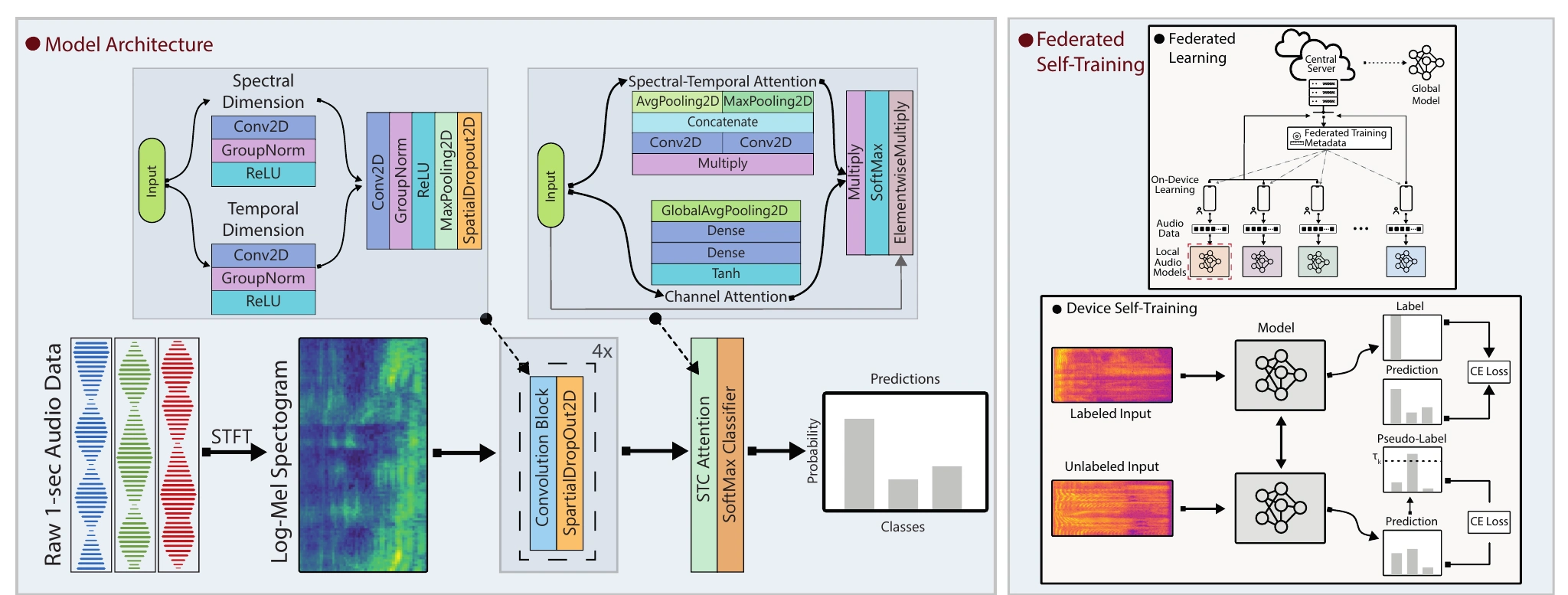
The method uses 64-bin log-mel features and four convolutional blocks. Predictions over non-overlapping utterance segments are averaged.
§III, public preprint p. 3. Method text specifies two-second segments; Figure 1’s one-second label is inconsistent.
02
Spectral, temporal and channel attention
Pooling and convolution produce spectral/temporal maps; pooled channels pass through a small perceptron. Their combined, softmax-scaled weights multiply the learned features.
§III and Figure 1. The illustration explains feature weighting, not a validated interpretation of human emotion.
03
Joint self-training
Known labels supply one cross-entropy term; confident predicted classes supply another. β controls the unlabeled contribution.
Eq. 1 and Algorithm 1. Temperature 2 is used when constructing pseudo-labels.
04
Participation-aware confidence and FedAvg
The threshold depends on global progress and local participation. Clients send updated parameters for data-weighted FedAvg aggregation.
§III–IV. The prose describes a threshold increasing from 0.5 to 0.9; printed Eq. 3 conflicts with that description, so no corrected schedule is inferred here.
Original paper figures & sourcesEnlargeSpectral, temporal, and channel attention help the local model represent speech. Federated self-training adds supervision from unlabeled audio, and clients share model updates with the server. Figure 1 · public preprint, p. 3 Evaluation
Results
Emotion recognition with 10% labels
IEMOCAP · four emotions · 8–10 clients · mean of five runs