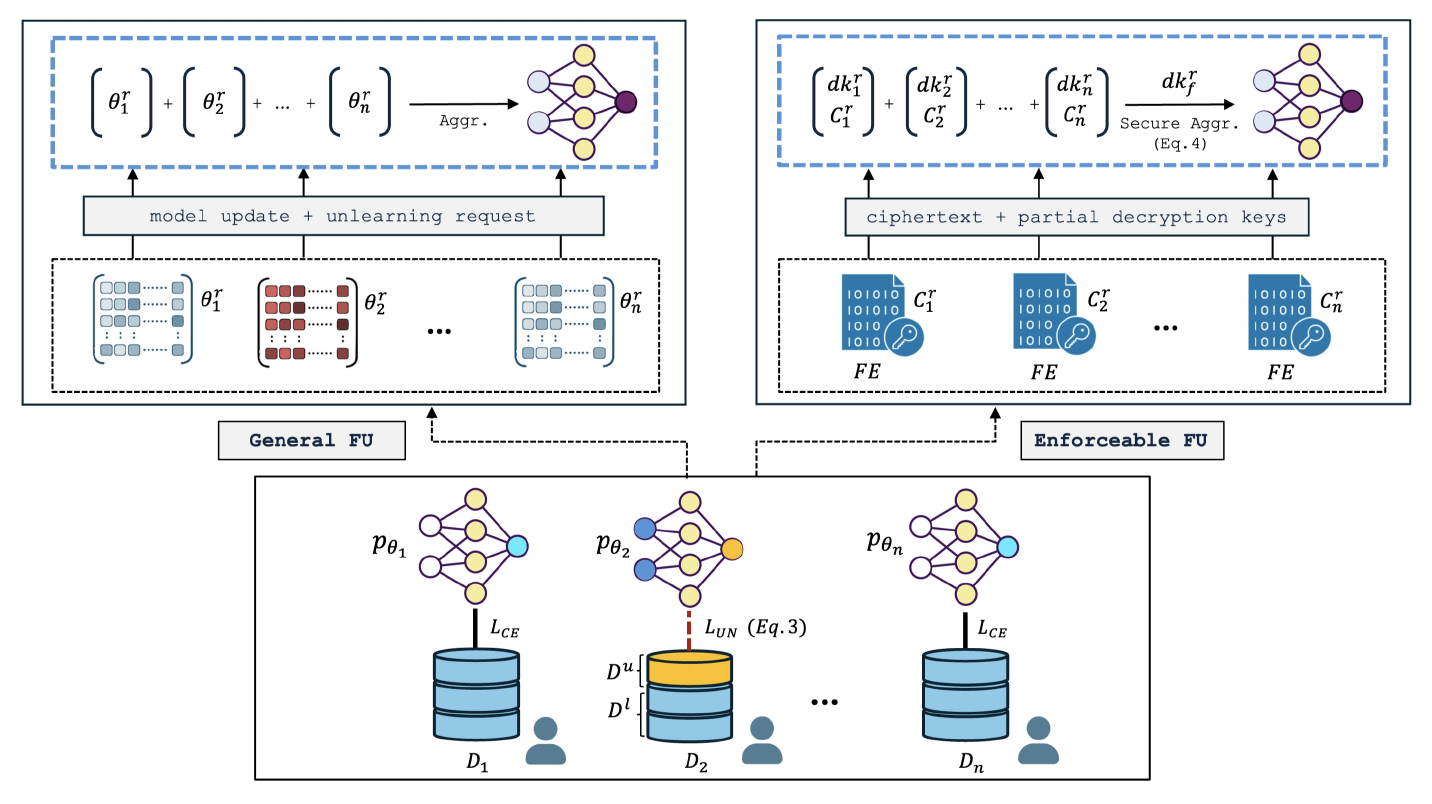
Bind learning and unlearning updates to an agreed aggregate. EFU uses client-side unlearning, weight clustering and functional encryption so both update types follow the same encrypted submission path. The study measures forgetting behavior and retained utility alongside signals that might reveal unlearning.
Inside EFU
A client learns or unlearns in a roundThe client receives the global model and takes one branch: normal learning on retained data, or unlearning on its designated forget set. These are alternative local actions, followed by the same submission pipeline.Combine a forgetting signal with stabilizersThe standalone objective negates cross-entropy on the forget set, adds cross-entropy on adversarial examples with incorrect labels, and penalizes parameter drift using inverted MAS importance. The adversarial examples are generated once offline.Share ciphertexts, a visible map and a key shareClustering replaces many weights with a small centroid set. Clients encrypt those centroids and send the position map directly, along with a partial functional key. The server expands the ciphertexts using this visible map; EFU does not use Binary Fuse filters.Authorize one round and one aggregation ruleFunctional keys bind permitted decryption to the agreed function and round. The guarantee concerns which aggregate can be decrypted under the stated key-sharing assumptions; it does not compel a server to continue executing or destroy earlier model copies.
What this adds
01
Client-controlled updates: clients either learn from retained data or compute an update intended to forget selected data.
02
Function-bound aggregation: encrypted centroids and partial keys restrict which aggregate the server can decrypt.
03
Forgetting at several levels: evaluate sample, class and task removal with a standalone objective and wrapped client-side unlearning methods.
Abstract
Federated unlearning (FU) algorithms allow clients in federated settings to exercise their “right to be forgotten” by removing the influence of their data from a collaboratively trained model. Existing FU methods maintain data privacy by performing unlearning locally on the client-side and sending targeted updates to the server without exposing forgotten data; yet they often rely on server-side cooperation, revealing the client's intent and identity without enforcement guarantees - compromising autonomy and unlearning privacy. In this work, we propose EFU (Enforced Federated Unlearning), a cryptographically enforced FU framework that enables clients to initiate unlearning while concealing its occurrence from the server. Specifically, EFU leverages functional encryption to bind encrypted updates to specific aggregation functions, ensuring the server can neither perform unauthorized computations nor detect or skip unlearning requests. To further mask behavioral and parameter shifts in the aggregated model, we incorporate auxiliary unlearning losses based on adversarial examples and parameter importance regularization. Extensive experiments show that EFU achieves near-random accuracy on forgotten data while maintaining performance comparable to full retraining across datasets and neural architectures - all while concealing unlearning intent from the server. Furthermore, we demonstrate that EFU is agnostic to the underlying unlearning algorithm, enabling secure, function-hiding, and verifiable unlearning for any client-side FU mechanism that issues targeted updates.
Abstract and overview follow the public preprint; the citation identifies the published version.
Algorithm 1 branches on the local forget set. A learning client minimizes cross-entropy on retained data; an unlearning client computes a removal update. Both then cluster, encrypt and submit through the same protocol.
Section 4.3 and Algorithm 1, PDF pages 6–7. Matching ciphertext format is one part of concealment, not a complete audit of observable metadata.
02
Regularize the removal update
The standalone loss combines a negative forget-set cross-entropy term, an auxiliary term for adversarial examples with incorrect labels, and inverted MAS importance weights that constrain parameter drift.
Equation 3, PDF page 6, with terms abbreviated. RMAS = ∑j(1 − Ωj)(θj − θ̃j)2; θ̃ is the model before unlearning. Offline adversarial preparation is excluded from the plotted local runtime.
03
Compress the encrypted submission
Encrypt κ centroid values under the current round label, transmit the visible position map, and include a partial functional key. The server expands encrypted centroids to weight positions and recovers a sample-weighted aggregate.
Sections 4.3–4.4 and Algorithm 2, PDF pages 7–8. The experiments use 64 centroids and 256-bit encryption.
04
Read function binding within its assumptions
The complete-aggregation argument requires at least one client to withhold a share for an altered function or label. Update-type indistinguishability excludes full collusion and is conditioned on indistinguishable function outputs. Visible maps, timing and other observations remain separate questions.
Section 4.5 and Appendix B, PDF pages 8 and 17–18. Trusted clients perform key generation, encryption and unlearning correctly. Authorized decryption does not enforce deployment or deletion of old models.
05
Separate empirical forgetting from exact erasure
Compare retained and forgotten accuracy with full retraining. Parameter-change and traffic plots describe observable behavior, but the paper does not train an intent detector or quantify its attack advantage. Low forgotten-class accuracy alone is not proof of complete information removal.
Tables 1–2 and Figures 2–3, PDF pages 9–12; Appendix C, page 18. The evaluated PGD and FedOSD wrappers add MAS, while SGA-EWC retains EWC; their optimization is not uniformly unchanged.
Original paper figures & sourcesEnlargeEFU carries learning and unlearning through the same encrypted aggregation protocol. Client updates are bound to a specified function, while the server recovers the aggregate. Figure 1 in the public preprint Evaluation
EFU approaches the retraining reference on forgotten-class behavior, with a utility cost. Retained CIFAR-10 accuracy is 2.39 percentage points below retraining. The complete baseline and wrapper comparison is shown; low forgotten accuracy is a behavioral measure, not an erasure certificate.
Retained accuracy (%)
Higher is better
0100
Full retrain
94.82
SGA-EWC
91.23
PGD
91.82
FedOSD
93.06
EFU + SGA-EWC
90.91
EFU + PGD
91.61
EFU + FedOSD
92.73
EFU
92.43
Forgotten accuracy (%)
Lower is better
0100
Full retrain
13.72
SGA-EWC
14.69
PGD
14.31
FedOSD
12.77
EFU + SGA-EWC
14.71
EFU + PGD
14.29
EFU + FedOSD
12.54
EFU
13.06
Experiment details
CIFAR-10, ResNet-18, class-wise forgetting of 10% of classes; 10 clients, 1 unlearning client, 20% participation, 100 rounds. Accuracy in %; higher retain and lower forget are desired. Means of 3 runs; no dispersion reported.
The PGD and FedOSD integrations also add MAS regularization. These are not pure encryption-only ablations; low forgotten accuracy alone does not prove removal of data influence.
Class forgetting with retained utility. CIFAR-10, ResNet-18, class-wise forgetting of 10% of classes; 10 clients, 1 unlearning client, 20% participation, 100 rounds. Accuracy in %; higher retain and lower forget are desired. Means of 3 runs; no dispersion reported.
Identity forgetting and gender retention are separate measurements. EFU reaches 5.12% identity accuracy and 95.37% gender accuracy, versus retraining’s 4.71% and 96.86%. This experiment uses all 30 clients with full participation.
Gender accuracy (%)
Higher is better
0100
Full retrain
96.86
SGA-EWC
93.54
PGD
94.81
FedOSD
95.02
EFU
95.37
Identity accuracy (%)
Lower is better
0100
Full retrain
4.71
SGA-EWC
19.47
PGD
10.32
FedOSD
5.01
EFU
5.12
Experiment details
LFW, ViT-B/32 with separate identity and gender heads; all 30 clients unlearn identity after round 50 of 100, with full participation. Test accuracy in %; higher gender and lower identity are desired. Means of 3 runs; no dispersion reported.
This is a system-wide two-task LFW experiment, not evidence that arbitrary tasks or individual identities can always be removed without collateral loss.
Remove identity, retain gender. LFW, ViT-B/32 with separate identity and gender heads; all 30 clients unlearn identity after round 50 of 100, with full participation. Test accuracy in %; higher gender and lower identity are desired. Means of 3 runs; no dispersion reported.
CIFAR-10, 30-identity LFW, and 62-class FEMNIST; pretrained ResNet-18 and ViT-B/32.
Federated setting
Flower simulations with Dirichlet concentration 0.1, 64 weight clusters, and a 256-bit DMCFE key; 1 local learning epoch and 5 unlearning epochs.
Compared with
Full retraining, SGA-EWC, PGD, FedOSD, and their EFU integrations; sample-, class-, and task-level experiments.
Privacy evidence
DMCFE-based proof sketches plus CIFAR-10 plots of aggregate parameter drift, local execution time, and message size; no tabulated detector accuracy.
Scope & limitations
The stated threat model trusts clients to generate keys and perform unlearning correctly. The decryption argument assumes the agreed function and no unauthorized alternative key; it does not force a server to continue training or deploy the returned model.
Encryption hides ciphertext contents under DMCFE assumptions. The server also sees mappings and aggregate outputs; the paper conditions update-type indistinguishability on indistinguishable function outputs, and its side-channel plots are not a general detection test.
The sample-wise rows report retained test accuracy but no forgotten-sample metric. Appendix C defines a prediction-gap proxy, but no numerical prediction-gap or membership-inference audit is reported.
The runtime comparison generates adversarial examples offline. Its measured local update time is not a complete accounting of unlearning preparation cost.
@inproceedings{mohammadi2025efu,
  title = {{EFU}: Enforcing Federated Unlearning via Functional Encryption},
  author = {Mohammadi, Samaneh and Tsouvalas, Vasileios and Symeonidis, Iraklis and Balador, Ali and Ozcelebi, Tanir and Flammini, Francesco and Meratnia, Nirvana},
  booktitle = {Proceedings of the 34th ACM International Conference on Information and Knowledge Management},
  year = {2025},
  pages = {2148--2158},
  publisher = {Association for Computing Machinery},
  doi = {10.1145/3746252.3761091},
  url = {https://doi.org/10.1145/3746252.3761091}
}