Federated learning keeps data on clients, but incorrect labels can affect the shared model. FedLN estimates client noise and offers three places to intervene.
Three alternative interventions
Training stays on each client
Clients learn from local data; the server combines their model updates.
A frozen encoder finds other local examples with similar image features. A vote among their stored labels corrects the sample’s label.
AKD · during training
For clients with detected noise, an embedding teacher guides local features alongside the original-label signal. The labels stay unchanged.
NA-FedAvg · at the server
After ordinary warm-up, clients send global- and local-model confidence scores once. The server estimates each client’s noise and reuses it to weight later updates by data share times estimated reliability.
Choose an intervention to fit the data and device.
Label patterns, pretrained representations and available computation determine which route is useful.
Abstract
Federated Learning (FL) is a distributed machine learning paradigm that enables learning models from decentralized private datasets where the labeling effort is entrusted to the clients. While most existing FL approaches assume high-quality labels are readily available on users’ devices, in reality, label noise can naturally occur in FL and is closely related to clients’ characteristics. Due to scarcity of available data and significant label noise variations among clients in FL, existing state-of-the-art centralized approaches exhibit unsatisfactory performance, whereas prior FL studies rely on excessive on-device computational schemes or additional clean data available on the server. We propose FedLN, a framework to deal with label noise across different FL training stages, namely FL initialization, on-device model training, and server model aggregation, able to accommodate the diverse computational capabilities of devices in an FL system. Specifically, FedLN computes per-client noise level estimation in a single federated round and improves the models’ performance by either correcting or mitigating the effect of noisy samples. Our evaluation on various publicly available vision and audio datasets demonstrates a 22% improvement on average compared to other existing methods for a label noise level of 60%. We further validate the efficiency of FedLN in human-annotated real-world noisy datasets and report a 4.8% increase on average in models’ recognition performance, highlighting that FedLN can be useful for improving FL services provided to everyday users.
A pretrained encoder maps each client’s examples into an embedding space. Nearby examples vote on the label. When that vote disagrees with the stored label, NNC replaces the label before federated training.
Examples and embeddings stay fixed. The fraction of disagreements also supplies a local noise estimate.
Count one vote per neighbor; keep the most frequent class.
g
Pretrained feature encoder.
Nk
Indices of the k nearest other local embeddings by Euclidean distance.
yj
The neighbor’s observed label; tied votes are broken randomly.
Useful embeddings help, but a neighborhood dominated by the wrong class can still vote incorrectly.
Noise estimation and source
The encoder is used locally during initialization. The per-client noise estimate is the number of vote–label mismatches divided by the client’s sample count. The displayed voting rule is a compact restatement, with repeated labels counted separately.
AKD keeps the observed labels and adds a teacher loss for clients with detected label noise. The teacher supplies pretrained embeddings or predictions from the aggregated global model.
The local model learns from its labels and this additional supervision in one combined objective.
Add teacher guidance when the client’s noise estimate activates it.
CE / KD
Cross-entropy label loss / knowledge-distillation teacher loss.
nlm, uε
Client m’s estimated noise and its threshold-based gate.
β
Controls the teacher loss’s contribution.
The teacher is extra supervision; it does not force a potentially incorrect replacement label.
Teacher losses and source
Embedding supervision uses mean absolute error. Global-model supervision uses Kullback–Leibler divergence between temperature-scaled outputs. The reported results on this page use embedding supervision.
After a warm-up period, clients compute energy scores using their local and global models. The server uses the scores to estimate each client’s label-noise level once.
Later rounds reuse those estimates: a client’s data share is multiplied by its estimated clean-label fraction.
Noisier clients contribute less to the shared model.
γm
Client m’s aggregation weight.
Nm / N
Its share of all training samples.
1 − nlm
Its estimated fraction of clean labels.
This avoids a separate pretrained encoder, but still depends on distinguishing relatively reliable clients.
One-time estimation and source
Energy scores come from the model’s output logits. Score computation and communication occur in the designated estimation round; subsequent rounds continue local training and noise-aware aggregation. The equation reproduces the paper’s weight without adding a normalization term.
Human-annotated training sets are randomly distributed across clients; evaluation uses the original clean test sets. There is no explicit clean-client group. Training uses one local epoch and 25% data-distribution variance. The figure reports no dispersion or error bars.
A controlled comparison · CIFAR-10
The same noise rate can produce opposite outcomes
Test accuracy (%)
Random noise
050100%
FedAvg57.65
FedCorr67.27
NNC74.76
AKD68.43
NA-FedAvg65.34
Class flipping
050100%
FedAvg63.54
FedCorr65.23
NNC54.59
AKD68.39
NA-FedAvg67.92
FedLN:NNCAKDNA-FedAvgShared 0–100% scale.
Test accuracy (%); higher is better
Method
Random noise
Class flipping
FedAvg
57.65
63.54
FedCorr
67.27
65.23
NNC
74.76
54.59
AKD (embeddings)
68.43
68.39
NA-FedAvg
65.34
67.92
NNC gains 17.11 points under random noise, yet falls below FedAvg under class flipping (54.59% vs 63.54%).
ResNet-20; 70% label noise on 80% of 30 clients; 200 rounds, one local epoch, 80% participation. Three-run means; AKD uses embeddings.
Noise sparsity changes from 0% to 100% while the corruption rate stays at 70%. Random noise spreads wrong labels across classes; class flipping concentrates them. These accuracy comparisons do not establish equal computation: FedCorr includes additional preprocessing and fine-tuning. Trial dispersion is not reported.
Inside label correction
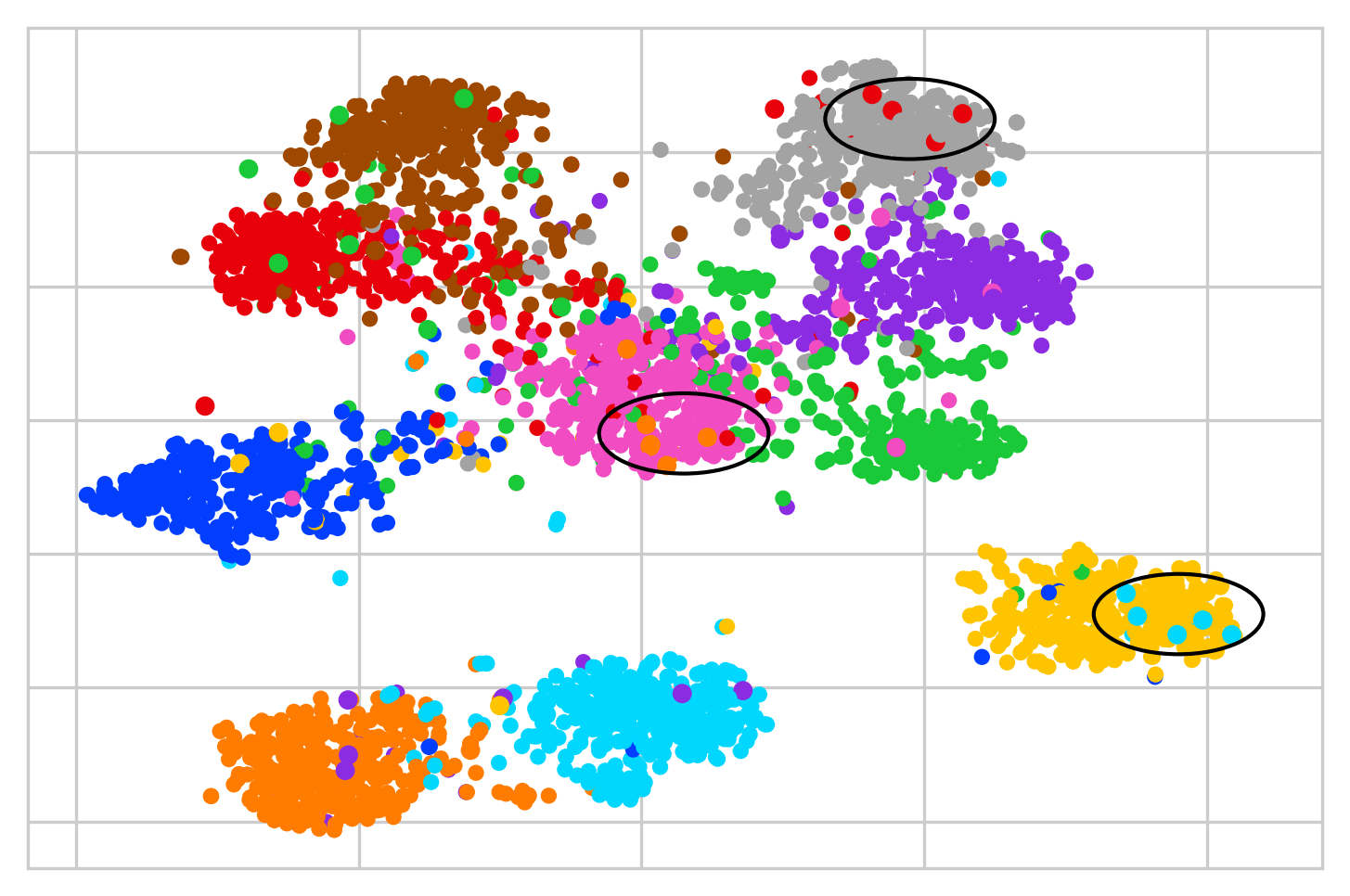
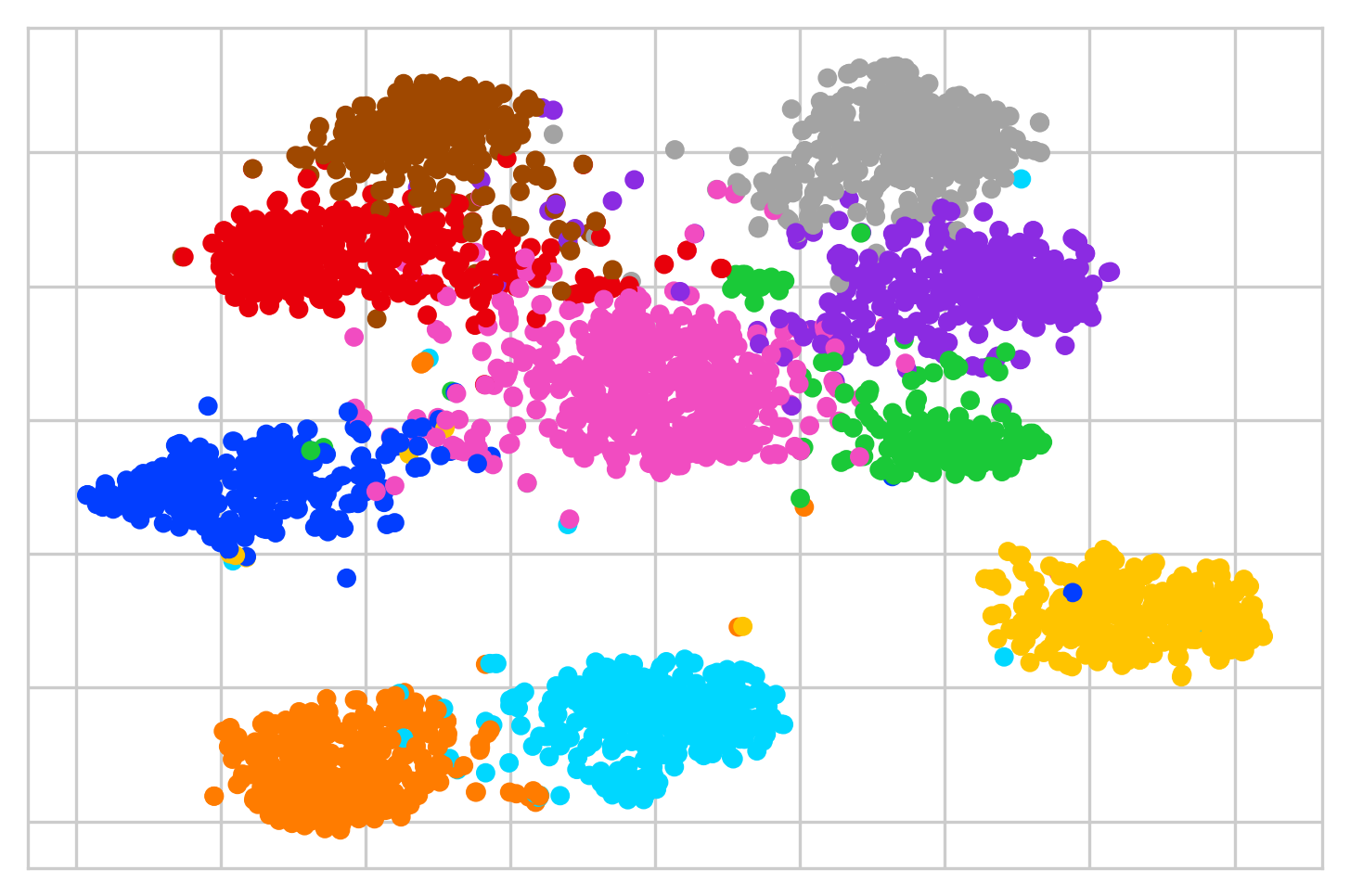
The points stay fixed. Their labels change.
Before NNC
After NNC
CIFAR-10 with 40% random label noise; fixed CLIP features. This illustrates relabeling, not learning a new representation. Figure 7
Audio
Accuracy (%)
Speech Commands v2 · 70% label noise on 80% of clients.
Speech Commands v2 · test accuracy (%)
Method
Random noise (%)
Class flipping (%)
FedAvg
72.34
72.39
Confident Learning
78.34
72.81
NNC
96.09
46.07
AKD (embeddings)
79.94
76.02
NA-FedAvg
79.12
80.37
NNC leads under random noise; NA-FedAvg under class flipping.
Noisy clients
Accuracy (%)
CIFAR-10 · 40% label noise per noisy client.
Share of noisy clients · test accuracy (%)
Noisy clients
NNC (%)
NA-FedAvg (%)
25%
73.80
75.99
50%
74.54
73.27
75%
73.50
70.99
100%
73.76
64.02
NA-FedAvg loses accuracy as clients with clean labels disappear.
From local data to a shared model
One federated loop. Three intervention points.
Choose one route. Each highlighted step shows where that method intervenes.
Before trainingEvery round · send shared model → train locally → aggregate ↻
NNC
Correct labels
Initialization
Neighbor vote → corrected labels
Encode local examples; replace each label with its neighbors’ majority vote.
Local training
Train on corrected labels
Minimize cross-entropy on each participating client.
Server aggregation
Sample-weighted FedAvg
Average client models by their share of training samples.
AKD
Guide local learning
Initialization
Estimate client noise
Count disagreements between local labels and embedding-based votes.
Local training
Label loss + teacher guidance
Keep observed labels; use estimated noise to gate the extra teacher loss.
Server aggregation
Sample-weighted FedAvg
Average client models by their share of training samples.
NA-FedAvg
Reweight updates
Initialization
Initialize the shared model
Start ordinary FedAvg, without an encoder or label correction.
Local training
Train on observed labels
At the estimation round, also send local/global-model energy scores.
Server aggregation
Data share × clean fraction
Estimate client noise once after warm-up; reuse its clean fraction (1 − noise) for aggregation.
Each round starts from the shared model; client data stay local.Algorithm 1
Takeaways
Match the intervention to the noise.
NNC
Neighborhood quality matters. Strong gains under random noise; incorrect majorities can hurt under class flipping.
AKD
Guide learning without replacing labels. Embedding-based AKD gives the highest CIFAR-100N accuracy among the compared methods.
NA-FedAvg
Reduce noisier clients’ influence. Reweight updates when client reliability can be distinguished.
@article{tsouvalas2024fedln,
  author = {Tsouvalas, Vasileios and Saeed, Aaqib and Ozcelebi, Tanir and Meratnia, Nirvana},
  title = {Labeling Chaos to Learning Harmony: Federated Learning with Noisy Labels},
  journal = {ACM Transactions on Intelligent Systems and Technology},
  year = {2024},
  volume = {15},
  number = {2},
  articleno = {22},
  numpages = {26},
  doi = {10.1145/3626242},
  url = {https://doi.org/10.1145/3626242}
}