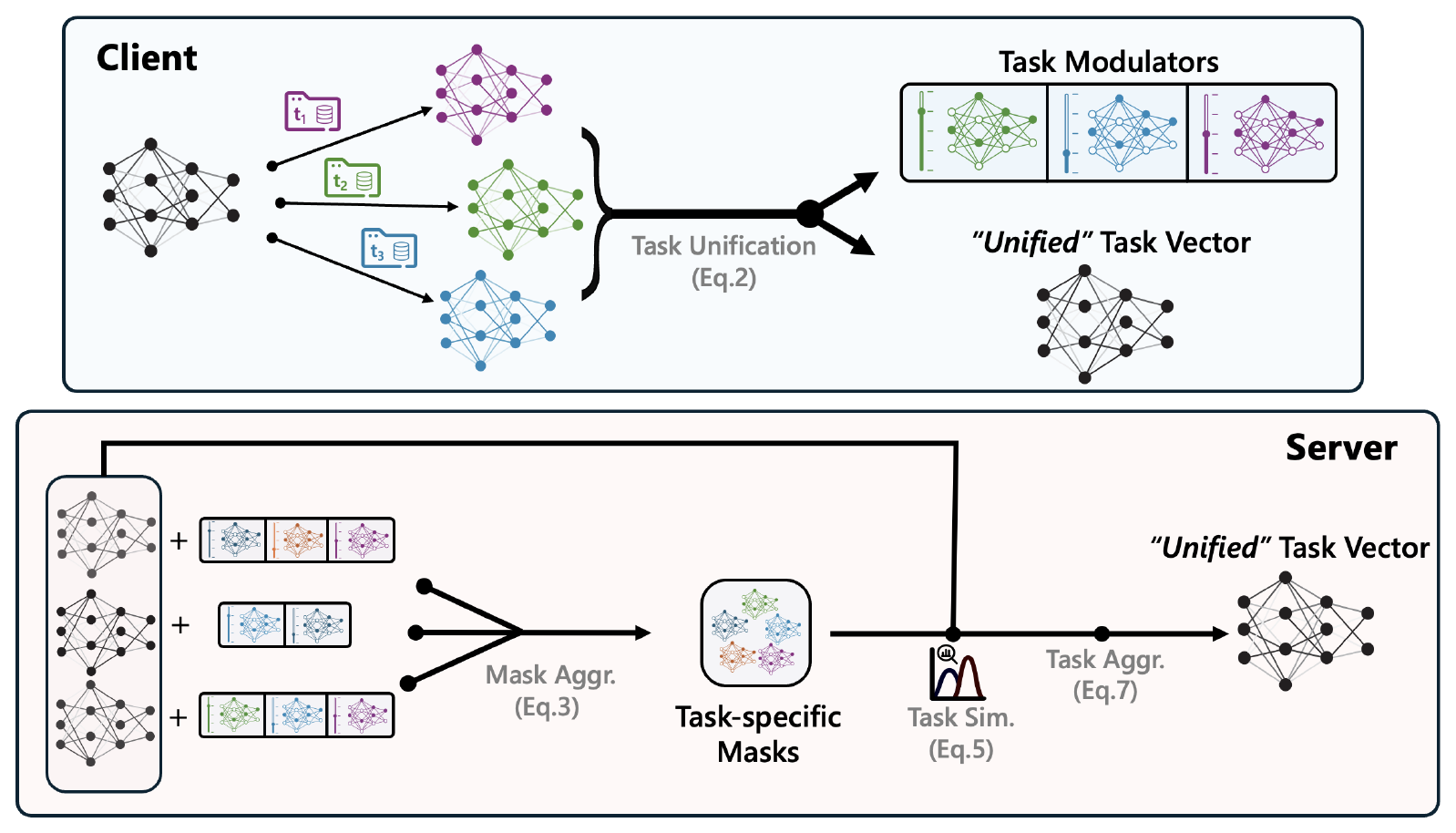
Clients with several tasks produce updates that can interfere. MaTU sends one unified task vector plus per-task masks and scalars, preserving task differences while enabling server aggregation within tasks and transfer between related tasks.
Inside MaTU
Measure each task from a common originClients train their assigned tasks individually. Each task vector is the difference between its fine-tuned weights and the same pretrained model, so all task updates share a reference point.Elect a sign and aligned magnitudeFor every coordinate, MaTU takes the sign of the sum of task updates. It then keeps the largest magnitude among entries with that sign. The schematic below illustrates one coordinate.Attach a mask and scalar for each taskA binary mask keeps coordinates whose signs agree with a task’s update; a scalar corrects the total magnitude. Clients send one unified vector together with these compact task-specific modulators.Aggregate within and across related tasksThe server first combines clients that share a task, using agreement masks. It then transfers updates from up to κ other tasks whose sign similarity exceeds 0.5, applying the receiving task’s mask.Recover task-specific updates for the next roundThe server reunifies updated task vectors for each client. On return, each task multiplies the unified vector by its mask and scalar, then adds the recovered update to pretrained weights. Recovery is approximate.
What this adds
01
Compact task representation: elect a shared vector and retain lightweight task-specific modulators.
02
Selective transfer: combine same-task updates with sign-aligned related tasks.
03
No retained client weights: the server computes task-level updates without storing client-specific models across rounds.
Abstract
Federated Learning (FL) traditionally assumes homogeneous client tasks; however, in real-world scenarios, clients often specialize in diverse tasks, introducing task heterogeneity. To address this challenge, Many-Task FL (MaT-FL) has emerged, enabling clients to collaborate effectively despite task diversity. Existing MaT-FL approaches rely on client grouping or personalized layers, requiring the server to manage individual models and failing to account for clients handling multiple tasks. We propose MaTU, a MaT-FL approach that enables joint learning of task vectors across clients, eliminating the need for clustering or client-specific weight storage at the server. MaTU constructs a single “unified” task vector per client and leverages lightweight task-specific modulators — binary masks and scalar rescalers — to disentangle and adapt per-task behavior. This design ensures stateless server aggregation and naturally scales to large task sets with minimal communication overhead. Evaluated across 30 datasets, MaTU achieves superior performance over state-of-the-art MaT-FL approaches, with results comparable to per-task fine-tuning, while delivering significant communication savings.
Each client fine-tunes its assigned tasks separately. A task vector is the change from the common pretrained weights. The experiments use ViT-B/32 with rank-16 LoRA on vision classification tasks.
Section 3.1 · p. 2. θt* denotes fine-tuned task weights and θp the shared pretrained origin.
02
Elect the unified vector
At each coordinate, take the sign of the sum of local task vectors. Among entries agreeing with that sign, retain the largest magnitude. This election preserves a common direction without averaging away its amplitude.
Equation (2) · p. 3. σ is the elected sign, μ the largest aligned magnitude; ⊙ denotes elementwise multiplication.
03
Retain task-specific modulation
Each task keeps a binary mask for entries aligned with its own signs and a scalar matching its original total absolute magnitude. These modulators produce approximate task updates from the unified vector.
Section 3.2, “Forming clients updates” · p. 4. Client and round indices are omitted consistently; mt is a task mask and λt its scalar.
04
Aggregate and return updates
The server uses task agreement masks to combine same-task clients, then transfers sign-aligned updates from up to κ related tasks with similarity above 0.5. It reunifies the updated vectors for each client and returns new masks and scalars for the next local-training round.
Equations (3)–(7) · p. 4. “Stateless” means no client-specific weights retained across rounds; task-level aggregation still occurs. Cross-task transfer is not uniformly beneficial in the ablations.
Original paper figures & sourcesEnlargeClients communicate one unified vector plus a binary mask and scalar for each task. The server combines same-task updates and transfers information between tasks whose update directions agree. Figure 1 in the public preprint Evaluation
MaTU reaches 84.32% average accuracy, above the evaluated federated baselines and 5.89 percentage points below individual centralized fine-tuning.
Accuracy (%)
Higher is better
0100
Individual (centralized)
90.21
FedAvg
64.60
NTK-FedAvg
65.13
FedProx
67.14
FedPer
82.11
MaT-FL
76.66
MaTU
84.32
Traffic (Mbits / task / round)
Lower is better
07
Individual (centralized)
— Not reported or not applicable in the source table
FedAvg
6.32
NTK-FedAvg
6.32
FedProx
6.32
FedPer
5.36
MaT-FL
6.32
MaTU
6.32
Experiment details
Eight vision tasks, ImageNet-21k-pretrained ViT-B/32 with rank-16 LoRA, 30 clients, 20% participation, one local epoch. Mean task accuracy (%), higher is better; reported bitrate in millions of bits per task per round, lower is better.
MaT-FL uses 300 rounds; the other federated methods use 100. The table supplies no uncertainty estimates, and per-round bitrate does not capture that round-count difference.
One task per client. Eight vision tasks, ImageNet-21k-pretrained ViT-B/32 with rank-16 LoRA, 30 clients, 20% participation, one local epoch. Mean task accuracy (%), higher is better; reported bitrate in millions of bits per task per round, lower is better.
MaTU exceeds MaT-FL by 11.87 percentage points while reporting 8.04 versus 20.43 million bits per task per round. It remains 10.74 points below individual centralized fine-tuning.
Accuracy (%)
Higher is better
0100
Individual (centralized)
90.21
FedAvg
51.63
NTK-FedAvg
56.06
FedProx
56.32
FedPer
48.37
MaT-FL
67.60
MaTU
79.47
Traffic (Mbits / task / round)
Lower is better
021
Individual (centralized)
— Not reported or not applicable in the source table
FedAvg
20.43
NTK-FedAvg
20.43
FedProx
20.43
FedPer
17.16
MaT-FL
20.43
MaTU
8.04
Experiment details
Same eight-task ViT-B/32 benchmark; 30 clients, task concentration ζt=0.5, 20% participation and one local epoch. Accuracy (%) is averaged across tasks; bitrate is millions of bits per task per round.
MaT-FL again uses 300 rounds versus 100 for the other methods. No seed count or uncertainty is specified for these table entries.
Several tasks per client. Same eight-task ViT-B/32 benchmark; 30 clients, task concentration ζt=0.5, 20% participation and one local epoch. Accuracy (%) is averaged across tasks; bitrate is millions of bits per task per round.
Vision classification with one backbone and adapter configuration.
MaT-FL uses 300 rounds versus 100 for MaTU in the eight-task tables; no repeated-run uncertainty is reported.
Per-task, per-round bitrate is not total training traffic; the 30-task study reports normalized accuracy.
Data
An eight-task vision benchmark and a larger 30-task vision benchmark; both class and task heterogeneity are simulated.
Model
ImageNet-21k-pretrained ViT-B/32 with LoRA rank 16; task vectors share the same pretrained origin.
Compared with
Individual centralized fine-tuning, FedAvg, NTK-FedAvg, FedProx, FedPer and MaT-FL.
Additional analysis
Task-relatedness metrics, 2–30 tasks per client, deliberately conflicting task groups and cross-task aggregation ablations.
Scope & limitations
All empirical tasks are vision classification with one backbone and adapter configuration; language or heterogeneous model architectures are not evaluated.
The main tables report no uncertainty, and MaT-FL is allocated three times as many rounds as the other methods.
The 30-task figure reports accuracy normalized to individual task fine-tuning, unlike the raw accuracy in the eight-task tables.
Cross-task transfer is not uniformly beneficial: the no-cross-task variant slightly exceeds MaTU in the two-conflict ablation in Figure 6b.