A new voice command should need examples, not a new training run. PLiX learns an acoustic embedding across languages, then recognizes unseen words by comparing a query with prototypes built from a few labeled support clips.
Inside PLiX
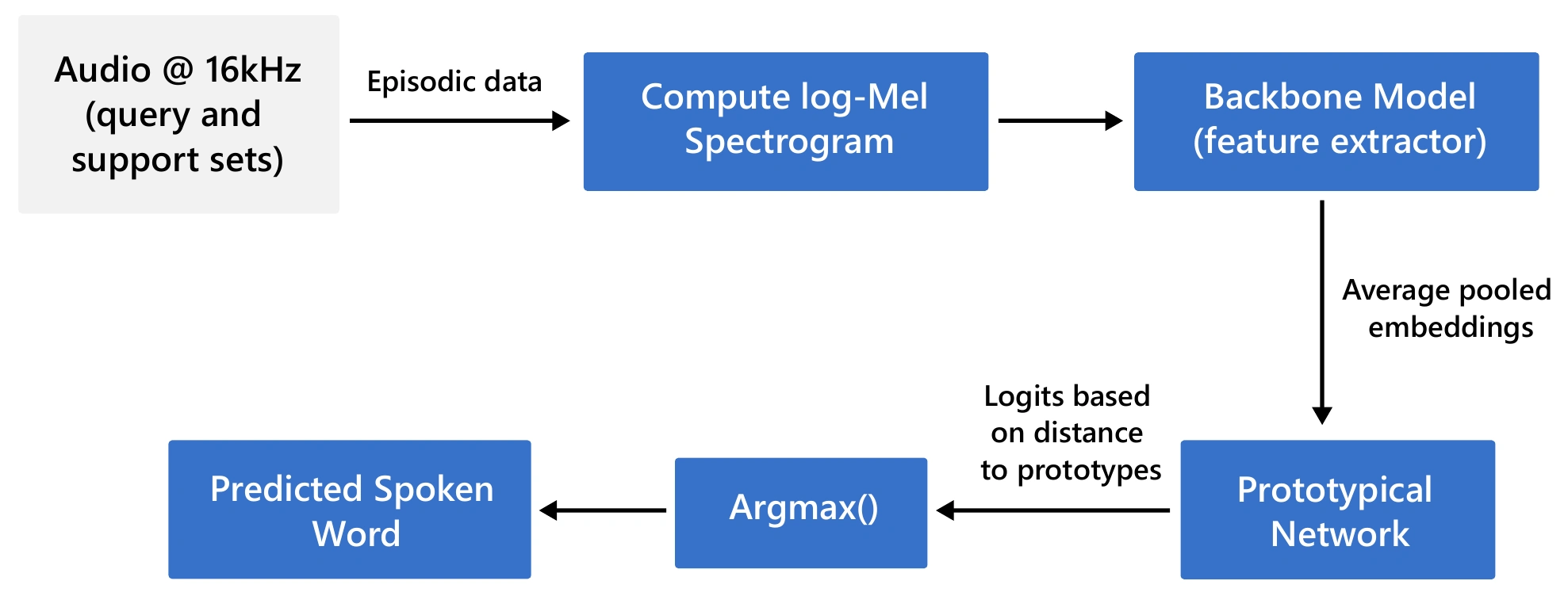
Learn through word episodesTraining repeatedly samples support and query clips from selected words. Query classification loss teaches the encoder to handle a changing vocabulary.Build support prototypesAt inference, labeled support clips pass through the frozen encoder. Average embeddings separately for each word; the resulting centroid is that word’s prototype.Compare a separate queryEmbed the incoming clip with the same encoder, then compare it with each prototype using squared Euclidean distance. The nearest prototype supplies its label.Replace the vocabularyNew support recordings define new word prototypes while the encoder stays fixed. Predictions select among the supplied words in a closed-set task.
What this adds
01
Multilingual episodic training learns to compare words across 20 languages.
02
Support-derived prototypes let a frozen encoder recognize a new vocabulary without retraining.
03
Transfer and hardware evaluation examine unseen languages, language identification and encoder latency/energy.
Abstract
As technology advances and digital devices become prevalent, seamless human-machine communication is increasingly gaining significance. The growing adoption of mobile, wearable, and other Internet of Things (IoT) devices has changed how we interact with these smart devices, making accurate spoken words recognition a crucial component for effective interaction. However, building robust spoken words detection system that can handle novel keywords remains challenging, especially for low-resource languages with limited training data. Here, we propose PLiX, a multilingual and plug-and-play keyword spotting system that leverages few-shot learning to harness massive real-world data and enable the recognition of unseen spoken words at test-time. Our few-shot deep models are learned with millions of one-second audio clips across 20 languages, achieving state-of-the-art performance while being highly efficient. Extensive evaluations show that PLiX can generalize to novel spoken words given as few as just one support example and performs well on unseen languages out of the box. We release models and inference code to serve as a foundation for future research and voice-enabled user interface development for emerging devices.
The multilingual base uses EfficientNet-v2 Medium, trained in 10-way, 5-shot episodes across 20 languages. Training and test vocabularies contain disjoint words.
§2.2–3.3. The TinyNet-E alternatives are separately trained language-specific models, not a compressed copy of the multilingual base.
02
Average support embeddings only
For a requested word c, encode each labeled support clip and average its embedding. The query is excluded from this computation.
§2.1.2, p. 3; Figure 1 explicitly separates the query path from mean pooling.
03
Classify without a weight update
Choose the prototype closest to the query embedding in squared Euclidean distance. Changing support clips changes the classifier while leaving encoder weights fixed.
§2.1.2, expressed equivalently to the paper’s argmax of negative squared distance. Most word tests use one-second clips.
04
Separate recognition from encoder cost
Recognition tests vary vocabulary size, support count and language. Hardware profiling measures encoder inference only on Raspberry Pi 4, Jetson Nano and Pixel 7.
Table 1 excludes log-mel extraction and prototype computation. Released weights and inference instructions are linked through aaqibsaeed/plixkws on Hugging Face.
Original paper figures & sourcesEnlargeA shared acoustic encoder maps support examples and incoming speech into the same space. Distances to the support-set prototypes determine which word was spoken. Figure 2 · public preprint, p. 4 Evaluation
The same encoder can recognize a new vocabulary from support clips. These are qualitative observations from separate recognition experiments.
Recognizing new words and languages. Qualitative reading of the recognition figures, not values estimated from bar heights. Held-out-word tests use closed-set MSWC episodes; transfer tests use five unseen MSWC languages and FLEURS. Accuracy is averaged over 1,000 episodes without plotted uncertainty intervals.
Evaluation
Observed result
Evidence
Multilingual base · held-out words
Recognizes new words with one support clip; accuracy varies by language and improves with more support.
Figure 6 · p. 9
English base · larger vocabulary
More competing words reduce one-shot accuracy; more support clips improve recognition.
Figure 7 · pp. 9–10
Multilingual base · unseen languages
Transfers without retraining to five languages; Tamil is the most difficult in the reported one-shot test.
Figure 10 · pp. 11–12
Multilingual base · language identification
Transfers to FLEURS without retraining; the ten-language episodes are harder than the smaller tasks.
Figure 11 · p. 12
Experiment details
Qualitative reading of the recognition figures, not values estimated from bar heights. Held-out-word tests use closed-set MSWC episodes; transfer tests use five unseen MSWC languages and FLEURS. Accuracy is averaged over 1,000 episodes without plotted uncertainty intervals.
These are qualitative observations from separate experiments, not a pooled performance comparison. English-only and multilingual encoders have different training data. FLEURS contains 102 languages, but each reported episode distinguishes only 3, 5 or 10 languages.
The small encoder is faster in every measured configuration. These timings exclude preprocessing and prototype computation.
Encoder latency (ms)
Lower is better
Small (ms)Base (ms)
04480
Raspberry Pi 4 · standard
240.17
4480
Jetson Nano · standard
35.12
1954
Pixel 7 · quantized
5.12
78.07
Raspberry Pi 4 · quantized
6.92
107.13
Jetson Nano · quantized
7.32
101.37
Experiment details
TinyNet-E (“Small”) and EfficientNet-v2 Medium (“Base”); average over 200 inference runs. Latency in milliseconds, lower is better; no dispersion reported.
Encoder-only timings exclude log-mel computation and the prototype classifier. Pixel 7 was tested only with quantized models; accuracy after quantization is not reported here.
Encoder latency. TinyNet-E (“Small”) and EfficientNet-v2 Medium (“Base”); average over 200 inference runs. Latency in milliseconds, lower is better; no dispersion reported.
The small encoder uses less energy in each measured configuration; quantization also lowers energy on the two directly comparable platforms.
Encoder energy (mJ)
Lower is better
Small (mJ)Base (mJ)
02012
Raspberry Pi 4 · standard
137.82
2011.44
Jetson Nano · standard
133.53
1227.24
Pixel 7 · quantized
3.55
39.71
Raspberry Pi 4 · quantized
4.15
71.75
Jetson Nano · quantized
4.92
64.37
Experiment details
Same encoders and device configurations as the latency panel; average over 200 inference runs measured with an external power monitor. Energy in millijoules, lower is better; no dispersion reported.
These are encoder costs under the reported measurement setup, not whole-application battery consumption or continuous listening cost.
Encoder energy. Same encoders and device configurations as the latency panel; average over 200 inference runs measured with an external power monitor. Energy in millijoules, lower is better; no dispersion reported.
This page describes arXiv:2305.03058v1, a 2023 preprint. The implementation source is aaqibsaeed/plixkws on Hugging Face.
Evaluation uses segmented, closed-set episodes. Continuous listening, unknown-word rejection and false-trigger rates are not evaluated.
FLEURS contains 102 languages, but reported episodes distinguish 3, 5 or 10 languages.
Data
MSWC: over 12 million one-second clips; 16,665 training and 4,174 test keywords across 20 languages, with disjoint keyword splits.
Models
EfficientNet-v2 Medium (52.8M parameters) for the base model; TinyNet-E (761,396 parameters) for language-specific small models; ImageNet initialization.
Transfer
Five unseen languages: Frisian, Mongolian, Maltese, Slovenian and Tamil; separate few-shot language-identification episodes on FLEURS.
Protocol
1,000 test episodes, normally 15 queries; number of classes and support examples varies. Hardware profiling uses Raspberry Pi 4, Jetson Nano and Pixel 7.
Scope & limitations
Recognition results are closed-set episodes over segmented clips; open-set rejection, false-trigger rates and continuous streaming keyword detection are not evaluated.
Generalization varies by language, vocabulary size and support count; the unseen-language experiment covers five languages, not all languages.
Hardware measurements exclude preprocessing and prototype computation, and the paper does not report a corresponding quantized-accuracy comparison.
Recognition accuracy is presented graphically without uncertainty intervals; the small models are trained separately per language and are not the single multilingual base model.
 HF
HF