An emotion model can fit one speech corpus and fail on another. DA-MLDG rehearses source-domain shifts during training and weights them with an energy-gap estimate. The study finds mixed generalization gains and exposes limits of the representations and benchmarks.
Inside DA-MLDG
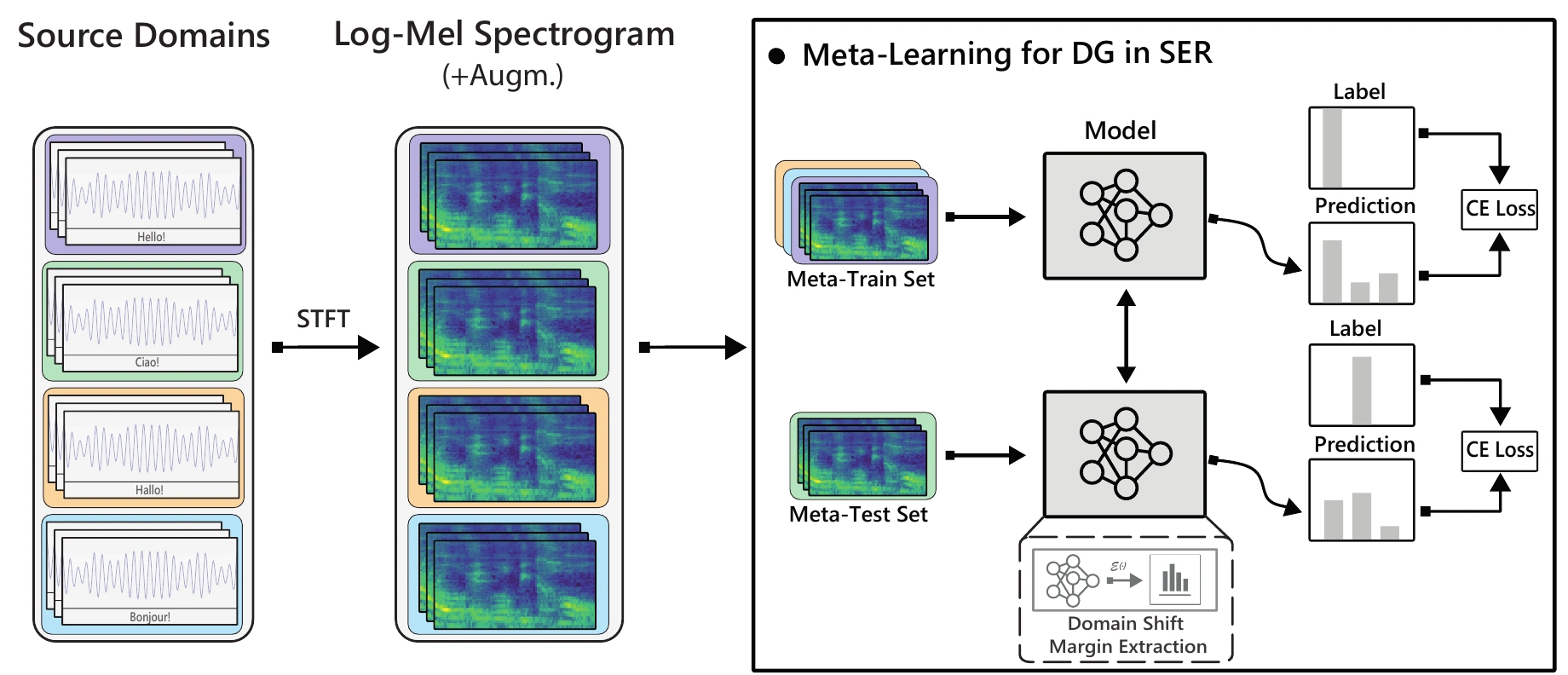
Split the source domainsRandomly divide source corpora into meta-train and meta-test subsets. Both are training sources; the final target corpus stays entirely outside this loop.Take the inner updateOne gradient step on the meta-train loss produces adapted parameters. The next operations ask how that update behaves on different source domains.Estimate the domain gapWith the adapted model, compute mean log-sum-exp energy on each source subset. The absolute energy difference becomes the meta-test loss weight.Optimize across the shiftCombine the meta-train loss with the weighted meta-test loss, accounting for inner adaptation. Resample the source split for the next iteration.Test the unseen corpusThe log-mel model beats the supervised Deep-All baseline in four of seven scenarios. Arrows show direction only; there is no universal gain or statistical-significance claim.
What this adds
01
Domain-shift-aware meta-learning weights the loss on a held-out source subset using an energy gap.
02
Seven cross-corpus scenarios make both improvements and failure cases visible.
03
Representation analysis compares log-mel inputs with TRILLsson embeddings without claiming domain shift is solved.
Abstract
Speech Emotion Recognition (SER) refers to the recognition of human emotions from natural speech, vital for building human-centered context-aware intelligent systems. Here, domain shift, where models’ trained on one domain exhibit performance degradation when exposed to an unseen domain with different statistics, is a major limiting factor in SER applicability, as models have a strong dependence on speakers and languages characteristics used during training. Meta-Learning for Domain Generalization (MLDG) has shown great success in improving models’ generalization capacity and alleviate the domain shift problem in the vision domain; yet, its’ efficacy on SER remains largely unexplored. In this work, we propose a “domain-shift aware” MLDG approach to learn generalizable models across multiple domains in SER. Based on our extensive evaluation, we identify a number of pitfalls that contribute to poor models’ DG ability, and demonstrate that log-mel spectrograms representations lack distinct features required for MLDG in SER. We further explore the use of appropriate features to achieve DG in SER as to provide insides to future research directions for DG in SER.
Partition source domains into disjoint sets S′ and V at each iteration. A gradient step on S′ produces adapted parameters θ′.
§III, Eq. 2 and Algorithm 1. V is a source meta-test subset, not the final target test corpus.
02
Use energy as a shift proxy
Compute each subset’s average log-sum-exp of logits with θ′ and temperature 1. The absolute gap supplies γ, the adaptive weight.
Eq. 3, printed p. 423. The score is proposed as a proxy for domain shift, not a measured distance between speech distributions.
03
Optimize the weighted outer objective
Minimize source training loss plus γ times meta-test loss after adaptation. The outer optimization accounts for how θ′ depends on θ.
Eq. 2. The formula presents the stated objective rather than Algorithm 1’s outer-update line, which omits an explicit gradient symbol.
04
Evaluate representation and transfer together
Compare ResNet-18 with log-mel inputs against a variant using TRILLsson embeddings. Seven source/target scenarios cover same-language and cross-language transfer.
Tables I, III and IV; ten trials per setting. The target corpora remain unseen during training.
Original paper figures & sourcesEnlargeTraining repeatedly simulates a domain shift between source datasets. The estimated shift controls the influence of the meta-test loss when updating the shared emotion model. Figure 1 · PerFail paper, p. 423 Evaluation
DA-MLDG beats Deep-All in four of seven scenarios and leads all four methods in only two. The exact table retains RSC and MLDG comparisons.
Accuracy (%)
Higher is better
Deep-All (%)DA-MLDG (%)
0100
1 · IEMOCAP
26.95
31.35
2 · RAVDESS
43.40
39.41
3 · TESS
47.03
46.80
4 · CaFE
43.16
43.21
5 · AESDD
60.65
62.26
6 · ShEMO
31.54
38.79
7 · ShEMO
40.19
37.11
Experiment details
Five-emotion SER with VoxCeleb-pretrained ResNet-18 and log-mel inputs; source and target corpora are defined in Table I. Mean target accuracy (%) over ten trials; higher is better. No dispersion is reported for these results.
Scenarios use different source corpora, so ShEMO appears twice with different training conditions. ShEMO lacks the disgust class. The small 0.05-point lead in scenario 4 has no reported uncertainty.
Generalization gains are uneven. Five-emotion SER with VoxCeleb-pretrained ResNet-18 and log-mel inputs; source and target corpora are defined in Table I. Mean target accuracy (%) over ten trials; higher is better. No dispersion is reported for these results.
TRILLsson improves DA-MLDG over its log-mel version in six scenarios, yet it beats the supervised embedding baseline in only three.
Accuracy (%)
Higher is better
Deep-All (%)DA-MLDG (%)
0100
1 · IEMOCAP
28.57
32.11
2 · RAVDESS
42.61
39.82
3 · TESS
50.16
48.46
4 · CaFE
45.09
43.29
5 · AESDD
61.17
64.11
6 · ShEMO
33.16
40.22
7 · ShEMO
41.15
36.97
Experiment details
The same seven SER scenarios using TRILLsson v3 EfficientNetv2-B3 embeddings as inputs to ResNet-18. Mean target accuracy (%) over ten trials; higher is better. No dispersion is reported.
These inputs add external pretraining. The results still show substantial target-domain errors and do not demonstrate practical readiness.
Stronger input representations. The same seven SER scenarios using TRILLsson v3 EfficientNetv2-B3 embeddings as inputs to ResNet-18. Mean target accuracy (%) over ten trials; higher is better. No dispersion is reported.
Evidence is from the PerFail / IEEE PerCom Workshops 2023 paper. Direct scenario rows are retained; inconsistent printed aggregates are not used.
Five selected emotions and limited corpora constrain the evidence; ShEMO lacks disgust samples. Its two scenarios use different source corpora.
Qualitative embedding plots suggest representation limitations but do not establish their causal explanation.
Data
Ten SER corpora: IEMOCAP, CREMA-D, SAVEE, RAVDESS, TESS, AESDD, CaFE, EMOVO, ShEMO and EmoDB.
Models
ResNet-18 with VoxCeleb pretraining; log-mel inputs or TRILLsson embeddings. A separate PACS image-domain comparison uses ImageNet initialization.
Compared with
Deep-All supervised training, vanilla MLDG with fixed weight, and Representation Self-Challenging (RSC).
Protocol
Seven corpus-transfer scenarios; five selected emotions; ten trials. Target corpora are held out from training.
Scope & limitations
The authors conclude that the achieved target-domain performance is insufficient for practical use; improvements are not consistent across baselines or scenarios.
Limited and largely acted corpora restrict coverage of natural speech variation; emotion categories can overlap acoustically.
ShEMO has no disgust examples, creating an imbalanced evaluation in scenarios 6 and 7.
The main comparison tables omit trial dispersion, limiting conclusions about small differences; t-SNE illustrations do not establish a causal explanation for failures.
@inproceedings{gandhi2023damldg,
  author = {Gandhi, Raeshak King and Tsouvalas, Vasileios and Meratnia, Nirvana},
  title = {On efficacy of Meta-Learning for Domain Generalization in Speech Emotion Recognition},
  booktitle = {2023 IEEE International Conference on Pervasive Computing and Communications Workshops and other Affiliated Events (PerCom Workshops)},
  year = {2023},
  pages = {421--426},
  note = {PerFail 2023: Second International Workshop on Negative Results in Pervasive Computing},
  doi = {10.1109/PerComWorkshops56833.2023.10150265},
  url = {https://doi.org/10.1109/PerComWorkshops56833.2023.10150265}
}